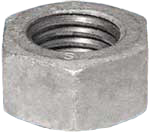
A connecting nut, or more commonly referred to as a coupling nut, is used to join two bolts, male threaded rods, or pipes together. It may also be used to extend length. It can join any two externally threaded objects as long as both are of the same diameter and thread pitch. For example, it can couple a hanger bolt and a threaded rod or two threaded rods.
At times, a coupling nut may also be used as a standoff or spacer to raise one part of an assembly higher than the other. If connecting two external items with different sizes, you should get the reducing connecting nut. There are instances as well when you need to tighten a rod assembly inware or to press it outward. Coupling nuts can also help you with either of those applications.
It is slightly different from a sleeve nut in that a coupling nut offers a right hand thread. Whereas, a sleeve nut offers both left and right hand threads plus it’s usually longer. The taper also begins in the middle to the end, with a stop in the middle.
Choosing the right connecting nut depends on your project.
Nuts and bolts that are either large or used for special applications need to meet a standard strength requirement. Hence, the grading in the name of this nut. Grade 8 bolt strength or class 8.8 means it’s high strength.
This classification means the nut is medium carbon steel, quenched and tempered. All sizes below 16mm means they have a Proof Lead of 580MPa, minimum Yield Strength of 640 MPa, and minimum Tensile Strength of 800 MPa. On the other hand, those that are more than 16mm above have a Proof Lead of 600MPa, minimum Yield Strength of 660 MPa, and minimum Tensile Strength of 830 MPa.
Grade 8 bolt strength is useful for motors, engines, railroad equipment, and processing equipment. This is because these bolts or nuts, as mentioned previously, have high tensile strength, enabling them to perform well in most environments. However, this is not advised in areas with extreme temperatures.
If you are replacing an existing nut, make sure to get either the same or a higher grade. Don’t replace Grade 8 bolt strength with a Grade 5.
Hot dip galvanization means this nut underwent a process that will prevent corrosion. It started with chemical cleaning and ended with the coating process.
Just like the Gr 8.8 Nut, this 2H nut is also hot dip galvanized which means it went through a process that will prevent it from corroding. Specifically, this process includes chemical cleaning to get rid of rust, dirt, oil, and other unwanted elements that may have attached to it. The second part is the coating process.
A 2H nut has a medium strength. Its primary uses are for pressure valves and vessels, pipelines, pressure controls, chemical, gasoline, and oil storage systems, natural gas and steam storage, and transmission of chemicals, gasoline, oil, steam, and natural gas.
Basically it’s best for high temperature applications and high-pressure conditions because it’s designed to withstand extreme environment conditions.
A 2H Nut should not be confused with a 2HM Nut. Although they have the same chemical composition, the manner they are tested are different. The former requires only a small sample to be tested while the latter needs the whole population to undergo testing.
The hardness requirements and the proof load between the two also differ. The 2H Nut has a Brinell Hardness minimum of 147 (depending on the size) while the 2HM’s is 159. The proof load of a ½ in. 2H and 2HM are 24, 830 and 21,800, respectively.
Nuts are another type of fastener with a threaded hole. Usually, a nut is the counterpart of bolt. Bolts can hold things together tightly thanks to the nuts. Nuts and bolts are used together to clamp two or more parts having unthreaded holes together. The two are kept together by a combination of several factors including the friction of their threads, stretching of the bolt, and compression of the parts that are to be held together.
To simplify, nuts are round discs that have a hole inside them used with bolts to fasten objects. In normal use, a nut-and-bolt joint holds together because the bolt is under constant tensile stress. The tensile stress pulls the nut threads against the bolt threads providing a clamping force that would prevent axial movement. However, when a joint is subjected to vibration, there is a tendency for the nut to easily loosen, therefore, specialized locking nuts are preferred in this situation.
A high-tensile nut means it can take on a high amount of stress before breaking. It can be used in environments which are often exposed to stressful and heated conditions. It’s used with bolts with less than the proof stress of the nut. Grade 8 bolt strength is useful for motors, engines, railroad equipment, and processing equipment. This is because these bolts or nuts, as mentioned previously, have high tensile strength, enabling them to perform well in most environments. However, this is not advised in areas with extreme temperatures.
Nuts are another type of fastener with a threaded hole. Usually, a nut is the counterpart of bolt. Bolts can hold things together tightly thanks to the nuts. Nuts and bolts are used together to clamp two or more parts having unthreaded holes together. The two are kept together by a combination of several factors including the friction of their threads, stretching of the bolt, and compression of the parts that are to be held together.
To simplify, nuts are round discs that have a hole inside them used with bolts to fasten objects. In normal use, a nut-and-bolt joint holds together because the bolt is under constant tensile stress. The tensile stress pulls the nut threads against the bolt threads providing a clamping force that would prevent axial movement. However, when a joint is subjected to vibration, there is a tendency for the nut to easily loosen, therefore, specialized locking nuts are preferred in this situation.
A high-tensile nut means it can take on a high amount of stress before breaking. It can be used in environments which are often exposed to stressful and heated conditions. It’s used with bolts with less than the proof stress of the nut. A grade-5 nut is made of medium-strength carbon steel according to the Society of Automotive Engineers. It’s equivalent to the metric 8.8. Bolt. Since it’s medium-strength, grade 5 high-tensile is not advisable for use in heavy manufacturing applications.