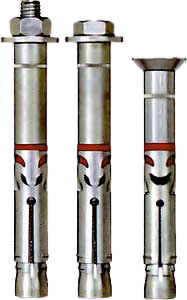
Frame fixings are designed to connect pressed metal door or window frame and the wall. This prevents the frames from being pulled against the substrate and offer a long-lasting fixing of the frame. To maintain strength overtime, the long shaft of metal frame fixing provides rigidity and extra grip strength. Metal frame fixings are recommended for applications such as window frames, door frames, and squared timbers. It is also compatible to a variety of building materials such as concrete, bricks, and others. A frame anchor attaches a door or window frame to the surrounding structure. Frame anchor is ideal for applications that are involved with wooden door or window frames. It is installed through drilling a hole through the frame and into the base material. The screw can be removed or reinstalled when necessary. This frame anchor can withstand heavier frames as it is made of a sturdy metal.
Hollow wall anchors are used for thin or hollow walls like drywall, plasterboard, or other board materials that cannot support heavy weights. They function through biting into the board or wall and expand within its cavity for it to be secured. Generally, hollow wall anchors are to be used on works where ordinary screws cannot be reliable at. The strength of the anchor depends on the size of its expansion
To install hollow wall anchors, one way is to use a hammer to tap it into wall until it is flat or even with the surface. Using a screwdriver, turn the screw clockwise until tight. This will expand the wings behind the drywall. Next, unscrew the screw from the hollow wall drive anchor. Lastly, insert the screw through the object you need to fasten and screw clockwise into the anchor until a resistance is felt.
Another method to install hollow wall anchor is to use the setting tool. Firstly, makes sure that there is enough space in the cavity to inset the anchor so it can expand. Drill a hole slightly smaller than the anchor. Insert the anchor and give it a light tap. Insert the nose piece of the tool between the flat collar and underside of the screw.
Hit anchors are made to anchor into concrete, brick, or block. They are typically recommended for attaching items that weight 50 pounds or less to solid masonry materials. This includes works in the garage, fireplaces, interior walls, among many others. The hit anchor comes with a nail that creates an expansion of the anchor in the solid masonry material it is intended to attach to. The need for a hammer to hit the nail is where hit anchor owes its name to. It is absolutely easy to complete hit anchor installation. The first step is to use a hammer drill with a tipped drill bit to drill a hole in the base material that is ¼” deeper than the wanted setting of the hit anchor. Clean out the debris in the created hole. Insert the anchor through the hole in the fixture and the hole in the base material. Hit the nail using a hammer into the hit anchor until the head is level to the top of the anchor. Remember that hit anchors are best suited for light duty fastening.