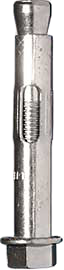
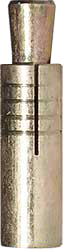
Sleeve anchors are incredibly versatile that you can use it in a wide variety of applications. These are also designed to be used in light to heavy duty fastening. When the bolt of the fastener is tightened, expansion occurs in the base material that creates a strong grasp and would allow distribution of load bearing weight. As mentioned, these anchors are very adaptable. They can be used in a plethora of applications as simple as those at the home or for much larger operations. These can also be beneficial for projects that has base materials such as concrete, brick, and block. Installing a sleeve anchor is simple but critical at the same time because correct installation is what would define its efficiency. The first step to install it is to drill a hole, make sure to clean the debris. Install the anchor afterwards and finish it with a hammer and torque wrench.
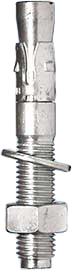
A wedge anchor is a mechanical type expansion. Wedge anchors are to be installed in solid concrete only and is not designed to be used for other materials such as bricks and hollow blocks. Among the mechanical type expansion anchors, wedge anchors have the highest value in consistency and quality. A wedge anchor has four parts. Its parts include the threaded anchor body, the expansion clip, a nut, and a washer.
Wedge anchors owe their holding values to its expansion against the base material. Upon inserting the hole to the concrete, expansion is created. Through turning the nut clockwise, the anchor body is pulled up to the nut.
When using wedge anchors, it is critical to note the distance between wedge anchors and the distance from an unsupported edge of the concrete. “Generally, the spacing requirements used in several industries are that the anchors should be spaced a minimum of 10 anchor diameters away from each other and a minimum of 5 anchors from an unsupported edge of the concrete.”
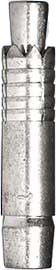
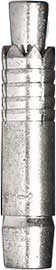
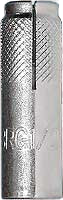
Dynabolt is made by Ramset in Australia and has became one of the most popular expanding anchor bolts. It has been designed to be an all-purpose all steel medium duty through fixing for masonry and concrete. It is called through fixing which means that you can position any item where you want it to be placed. For example, a timber frame, just drill through it and into the masonry and insert the bolt without moving the frame. This feature of Dynabolts saves you from the usual hassle in attaching something including positioning, marking the wall, and moving the frame while you drill.
Dynabolts are designed for fixing to concrete, solid, and hollow brick, masonry, and natural stone. There is a variety of applications Dynabolts can be efficient at including timber to concrete fixing, ductworks, pipe brackets, signs, and a lot more. However, one of the drawbacks its users find is that it is quite difficult to remove once the need to arises.
Self drilling anchors (SDA) are perfect for unstable ground conditions because they are a special type of rod anchors. It may be used in gravel, sand, clays, soft to medium fracture rock formations, and silt. This is because SDAs work well with difficult soil conditions and limited access. Therefore, you can benefit from extra corrosion protection, decreased material cost, and high installation rate.
SDAs are applied to underpinnings, earth retention, new construction, tunneling, settlement, and stabilization.
Self drilling anchor consists of a hexagonal nut, a bearing plate, extension couplings, a sacrificial drill bit, and hollow anchor rod.
The productivity of installing a self drilling anchor relies heavily on the sacrificial drill bit. Unlike other drill bits, the ones that come with SDA must meet several criteria. One it should be of high-quality, have enough length (proportionate to the anchor), and meet geology and geometry requirements.
There are a variety of applications possible for construction anchors. Typically, they are used to secure objects to materials that are normally resistant to screw or nails, for example, concrete. There are a lot of different types of anchors to choose from depending on your needs. Structural members which need anchors to be attached to masonry involves ledger beam, girders, floor and roof diaphragms, and other materials that might need to transfer their load to the masonry. Not only do anchors transfer gravity loads to masonry but they also can transfer lateral loads as well. Cut anchor is a specific type of anchors that is mostly used in concrete. It allows a protrusion-free installation of hex bolts, push-in fittings, and suspension bolts after installation. It is one of the most common and highly reliable tapped anchors. Like the other types of anchors, it is installed through drilling a hole, positioning it inside, and hammering it in with striking rod.
A drop-in anchor is a female anchor, that is it’s internally threaded. It’s designed only for solid concrete, just like the wedge anchor. It cannot be used with other types of materials such as brick or block-based. A drop-in anchor is dropped into a pre-drilled hole before it expands using a setting tool. The size of a drop-in anchor is determined by the inside diameter.
There are a variety of applications possible for construction anchors. Typically, they are used to secure objects to materials that are normally resistant to screw or nails, for example, concrete. There are a lot of different types of anchors to choose from depending on your needs.
Structural members which need anchors to be attached to masonry involves ledger beam, girders, floor and roof diaphragms, and other materials that might need to transfer their load to the masonry. Not only do anchors transfer gravity loads to masonry but they also can transfer lateral loads as well.
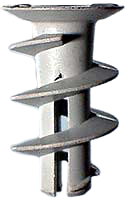
Plasterboard fixing GK is known to take the least installation time in gypsum plasterboard. But because of its spiral design, it may also be used in concrete walls even when the thickness of the wall panel is unknown. It’s made from high-quality nylon, which makes the installation stand the test of time.
Plasterboard fixing GK is used in pre-positioned installation. The spiral design allows the installation to fit snugly in place. It’s used with wood, sheet metal, and chipboard screws up to 5mm thick. Eye screws and hook may be used as well.
Fixings are a general term for items designed to attach objects to certain surfaces such as floors, walls, roofs, doors, and the likes, holding them steadily, usually permanently. They are a form of connector and play a particularly important role in construction.
Fixing is usually the key component in attaching larger or immovable objects. Examples include fixing a cupboard to a wall, a handle to a door, or a timber joist to a wall plate. Just like anchors, fixings also need to resist pull forces and shear forces.
Generally, washers are defined as thin disc-shaped plates, typically with a hole through the center, that are used in conjunction with a threaded fastener such as a screw or a bolt. The usual functions of washers include distributing load, creating separation, preventing corrosion and wear, locking fasteners, and reduce vibration.
A flat washer, also known as a plain washer, is a type of washer that is a flat annulus or ring which is used to spread the load of a screwed fastener and prevent damage to the surface being fixed.
Flat washers are generally used to increase the bearing surface of a nut or fastener’s head. It spreads the clamping force over a larger area. Washers may be useful when dealing with soft materials and oversized or irregularly shaped holes. It is usually assembled around a bolt or screw, between the bearing surface of the fastener and the part to which it is attached. Flat washers are used to improve stress distribution, and to span large clearance hole.
A B.I. flat washer means it’s black iron instead of galvanized iron. The latter has zinc to prevent corrosion. The disadvantage of this, however, is it can’t be used in gas lines as the zinc starts to react with gas, causing flaking, overtime.
Knowing the materials you need for fixing would totally save you from unwanted detachments and accidents. For instance, a cavity wall fixing is a method of attaching or supporting something to a wall when the wall is hollow or has a space behind it. Securing items to these types of walls therefore requires a strong and reliable cavity wall fixing to protect both your wall and the item you wish to attach.
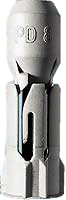
If you’re looking for a flexible expansion plug for gypsum plasterboard and fiberboard or any wooden panel, board fixing PD is the best option. It has a high level of installation security.
It’s made from high-quality nylon and used in pre-positioned installation. It can be used in both low-cavity depths and any thickness of board panel.
It works by expanding in the building material once the screw is tightened then the cone is pulled into the sleeve. It’s compatible with almost all hook and eye screws as long as the diameter does not exceed 6mm.