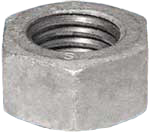
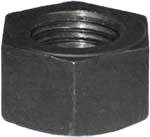
Just like the Gr 8.8 Nut, this 2H nut is also hot dip galvanized which means it went through a process that will prevent it from corroding. Specifically, this process includes chemical cleaning to get rid of rust, dirt, oil, and other unwanted elements that may have attached to it. The second part is the coating process.
A 2H nut has a medium strength. Its primary uses are for pressure valves and vessels, pipelines, pressure controls, chemical, gasoline, and oil storage systems, natural gas and steam storage, and transmission of chemicals, gasoline, oil, steam, and natural gas.
Basically it’s best for high temperature applications and high-pressure conditions because it’s designed to withstand extreme environment conditions.
A 2H Nut should not be confused with a 2HM Nut. Although they have the same chemical composition, the manner they are tested are different. The former requires only a small sample to be tested while the latter needs the whole population to undergo testing.
The hardness requirements and the proof load between the two also differ. The 2H Nut has a Brinell Hardness minimum of 147 (depending on the size) while the 2HM’s is 159. The proof load of a ½ in. 2H and 2HM are 24, 830 and 21,800, respectively.
An ASTM A325 nut (now ASTM F3125) means the nut has mechanical properties that range from ½ – 1” and 1⅛ – 1 ½”, tensile strength of 120 min and 105 min, and Yield strength of 92 and 81 minutes. It’s almost equivalent to a Grade 8.8 nut rating. It can be made from weathering steel, medium carbon steel, boron steel, and medium carbon alloy steel.
Nuts are another type of fastener with a threaded hole. Usually, a nut is the counterpart of bolt. Bolts can hold things together tightly thanks to the nuts. Nuts and bolts are used together to clamp two or more parts having unthreaded holes together. The two are kept together by a combination of several factors including the friction of their threads, stretching of the bolt, and compression of the parts that are to be held together.
To simplify, nuts are round discs that have a hole inside them used with bolts to fasten objects. In normal use, a nut-and-bolt joint holds together because the bolt is under constant tensile stress. The tensile stress pulls the nut threads against the bolt threads providing a clamping force that would prevent axial movement. However, when a joint is subjected to vibration, there is a tendency for the nut to easily loosen, therefore, specialized locking nuts are preferred in this situation.
A long nut is another term for a coupling nut or a connecting nut. A connecting nut, or more commonly referred to as a coupling nut, is used to join two bolts, male threaded rods, or pipes together. It may also be used to extend length. It can join any two externally threaded objects as long as both are of the same diameter and thread pitch. For example, it can couple a hanger bolt and a threaded rod or two threaded rods.
At times, a coupling nut may also be used as a standoff or spacer to raise one part of an assembly higher than the other. If connecting two external items with different sizes, you should get the reducing connecting nut. There are instances as well when you need to tighten a rod assembly inware or to press it outward. Coupling nuts can also help you with either of those applications.
It is slightly different from a sleeve nut in that a coupling nut offers a right hand thread. Whereas, a sleeve nut offers both left and right hand threads plus it’s usually longer. The taper also begins in the middle to the end, with a stop in the middle.
A hi nut or high nut or tall nut is used when a standard hex nut is too thin for the application, particularly in automotive or industrial equipment. Another reason high nuts are used is the fact that there’s an increased thread engagement with the screw or the bolt. This means there’s more room for wrenching. High nuts are commonly used with lock washers.
Nuts are types of fastener with a threaded hole. Usually, a nut is the counterpart of a bolt. Bolts can hold things together tightly thanks to the nuts. Nuts and bolts are used together to clamp two or more parts having unthreaded holes together. The two are kept together by a combination of several factors including the friction of their threads, stretching of the bolt, and compression of the parts that are to be held together.
To simplify, nuts are round discs that have a hole inside them used with bolts to fasten objects. In normal use, a nut-and-bolt joint holds together because the bolt is under constant tensile stress. The tensile stress pulls the nut threads against the bolt threads providing a clamping force that would prevent axial movement. However, when a joint is subjected to vibration, there is a tendency for the nut to easily loosen, therefore, specialized locking nuts are preferred in this situation.
Lock nuts or locknuts, also called self-locking nuts, are used when a resistance to vibration is needed. Other nuts get deformed under torque and vibrations but not locknuts.
Nuts are another type of fastener with a threaded hole. Usually, a nut is the counterpart of bolt. Bolts can hold things together tightly thanks to the nuts. Nuts and bolts are used together to clamp two or more parts having unthreaded holes together. The two are kept together by a combination of several factors including the friction of their threads, stretching of the bolt, and compression of the parts that are to be held together.
To simplify, nuts are round discs that have a hole inside them used with bolts to fasten objects. In normal use, a nut-and-bolt joint holds together because the bolt is under constant tensile stress. The tensile stress pulls the nut threads against the bolt threads providing a clamping force that would prevent axial movement. However, when a joint is subjected to vibration, there is a tendency for the nut to easily loosen, therefore, specialized locking nuts are preferred in this situation.
Nuts are another type of fastener with a threaded hole. Usually, a nut is the counterpart of bolt. Bolts can hold things together tightly thanks to the nuts. Nuts and bolts are used together to clamp two or more parts having unthreaded holes together. The two are kept together by a combination of several factors including the friction of their threads, stretching of the bolt, and compression of the parts that are to be held together.
To simplify, nuts are round discs that have a hole inside them used with bolts to fasten objects. In normal use, a nut-and-bolt joint holds together because the bolt is under constant tensile stress. The tensile stress pulls the nut threads against the bolt threads providing a clamping force that would prevent axial movement. However, when a joint is subjected to vibration, there is a tendency for the nut to easily loosen, therefore, specialized locking nuts are preferred in this situation.
A flange nut is with an integrated washer, which looks like a wide flange at one end. The purpose of this flange is for the distribution of pressure as the nut is being secured in place, particularly in an uneven surface. The flange may also be serrated if locking action is needed.
From the name itself, a hexagonal nut is a nut with a hexagon-shaped head. Threads of the hex nut are either right-hand or left-hand. The size of hex nuts refers to the nominal thread diameter, which is typically from ¼” to 2 ½”.
Hex nuts are used with other fasteners such as bolts, threaded rods, anchors, studs, or screws. Other fasteners may also be used along with it.
A G.I. hexagonal nut means it’s galvanized iron. A galvanized iron hex nut received an additional zinc coating to protect the nut from weather-related degradation, that is, moisture and oxygen.
Using hex nuts with other fasteners need careful installment to ensure full thread engagement. When using with bolts or screws, make sure that either of these two is long enough that there’s two more full threads beyond the nut face once it’s tightened.
The primary difference between the ordinary and imported hex nut is the materials used. Both are of high-quality, but the latter is more reliable for heavy applications.
A B.I. hexagonal nut means it’s coated with black iron instead of galvanized iron. The latter has zinc to prevent corrosion. The disadvantage of this, however, is it can’t be used in gas lines as the zinc starts to react with gas, causing flaking, overtime. So using B.I hex nut in such applications is better.
From the name itself, a hexagonal nut is a nut with a hexagon-shaped head. Threads of the hex nut are either right-hand or left-hand. The size of hex nuts refers to the nominal thread diameter, which is typically from ¼” to 2 ½”.
Hex nuts are used with other fasteners such as bolts, threaded rods, anchors, studs, or screws. Other fasteners may also be used along with it.
Using hex nuts with other fasteners need careful installment to ensure full thread engagement. When using with bolts or screws, make sure that either of these two is long enough that there’s two more full threads beyond the nut face once it’s tightened.
The primary difference between the ordinary and imported hex nut is the materials used. Both are of high-quality, but the latter is more reliable for heavy applications.
An anchor nut, sometimes called a plate nut, is a self-locking, self-wrenching fastener. It provides a permanent nut element in a material so that other materials can be attached to it using a screw. In fact, it is a reliable way of making sure nuts and screws (for additional components) are placed exactly where they should be onto a workpiece.
It’s particularly used for space constrained areas, ones that are difficult to access, or spots that are not thick enough, commonly known as inaccessible or blind locations. Basically, areas where threads would be too big. A plate nut is also recommended in areas where welding is not advisable. The heat coming from the welding process can weaken a surface, which may cause deformities and breakage later on. However, for stress purposes, a plate nut may be welded in place. This is because drill holes will be minimized. An anchor nut is ideal for stressed-skin applications because using these fasteners do not require additional stresses around the bolt hole.
Anchor nuts come in different styles. There are those with lugs and those without. This plate nut doesn’t come with lugs. Instead, it’s designed to be built right into the workpiece. It will be secured using rivets.