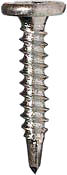
Tek screws are self drilling screws. Tek is actually the renowned brand name of self-drilling screws. This means you don’t need to drill a hole before installing these screws. Of course, however, tek screws can be used on soft materials only such as wood and thin metal. Its self-tapping thread and drilling point allow them to be installed without using a drill.
Screws are headed and have a cylindrical, threaded body as well. However, the thread on screws are capable of piercing a surface. Also screws do not require nuts and washers to keep them in place. For this reason, screws may be drilled directly into a surface while bolts require a pre-drilled hole. This is why the opposite end of screws are usually sharp–to help pierce a surface easily.
Screws are also a major category of threaded fasteners. Screws and bolts share a lot of likenesses such as being made of metal and being characterized by a helical ridge. They are both used to fasten materials by the engagement of the screw thread or the external thread with a similar internal thread in the matching part.
Both wafer screws and tek screws are self drilling screws. This means you don’t need to drill a hole before installing these screws. Of course, however, tek screws can be used on soft materials only such as wood and thin metal. Its self-tapping thread and drilling point allow them to be installed without using a drill.
Screws are headed and have a cylindrical, threaded body as well. However, the thread on screws are capable of piercing a surface. Also screws do not require nuts and washers to keep them in place. For this reason, screws may be drilled directly into a surface while bolts require a pre-drilled hole. This is why the opposite end of screws are usually sharp–to help pierce a surface easily.
Screws are also a major category of threaded fasteners. Screws and bolts share a lot of likenesses such as being made of metal and being characterized by a helical ridge. They are both used to fasten materials by the engagement of the screw thread or the external thread with a similar internal thread in the matching part.
A set screw is the type of screw used if a nut is not needed or cannot be incorporated in the application. It’s also called a blind screw or a grub screw. Set screws are mainly used when one needs to secure an object against another object or within another object, for example, a pulley to a shaft or a potentiometer knob. The set screw locks it in place. Set screws are driven into a threaded hole in the outer object and then tightened against the inner one.
What sets set screws apart from the other screws is that they’re fully threaded. However, there are types such as the Square Head Set Screw that has an unthreaded head. Square head set screw can be cone point, cup point, flat square, half dog square, or oval point square. Cone point has a cone shaped head and the tip has a sharp point. Cup point has a slightly circular and concave shape. Flat has a flat circle metal. Half dog is half as long as Full Dog. Oval point has a convex circular head.
Set screws are used with a hex socket, torx screws, square socket, or a slot–basically, any internal-wrenching drive.
Fasteners such as socket head cap screws, also known as Allen Head screws, have sockets within their heads so that Allen wrench could secure the screw. A socket head capscrew, also known as socket cap screw, socket screw, or allen bolt is a screw characterized by its head having a hexagonal socket. Allen or hex socket is the primary driver used and is to be torqued using an Allen wrench, also called a hex key. Allen socket screws are often seen as advantageous over the normal Philip’s head. Allen screw head has six pressure points while the other one has only four. With more pressure points, it is easier to grip the screw making Allen screws preferable.
Capscrews fasten machines together with the help of a nut. When tightened, capscrews fastened different parts together using the tensile load that’s created when the screws are tightened. This is because this action creates stretching of the screws.
Unlike the stainless steel allen socket-head capscrew, this one has less protection against corrosion although it’s durable just the same.
Allen screws are screws characterized by its head having a hexagonal socket. Allen or hex socket is the primary drive used and is to be torqued using an Allen wrench, also called a hex key. Allen socket screws are often seen as advantageous over the normal Philip’s head. Allen screw head has six pressure points while the other one has only four. With more pressure points, it is easier to grip the screw making Allen screws preferable.
Set screws are also known as blind screws which are a type of screw usually for attaching and securing an object against another object. The most common example of application of set screws is securing a pulley or gear to a shaft. When considering registering the gear, collar, or any similar disc-shaped object to a part of the shaft, a flat can be machined into the shaft, then the end of the set screw is pressed against to secure it. Socket set screws are especially designed for preventing movement of a pulley or any similar machine part relative to a shaft.
Stainless steel screw and sockets would often offer incredible advantages over screws and sockets made with ordinary materials. Its advantages include being resistant to corrosion and it requires low maintenance among the others. It might cost a little more than the ordinary materials, but it has a lasting value.
If you love hanging pictures, paintings, or other items in your house or office, hook screws might be familiar to you. Hook screws are a small hook with a pointed, threaded shank for screwing into woodwork or paneling, and a curved hooked end. To install hook screws, find a ceiling joist where you want to hang your hook. Use a pencil to mark your desired location for the hook screw in the joist. Drill a pilot hole to the ceiling joist. When choosing a drill bit, go for a slightly smaller one than the hook screw. Drill slightly deeper than the length of the threaded shaft of the hook screw. Remember to drill the hole not too widely or shallowly. If the hole is too wide, the hook screw won’t have anything to hold on to, making it loose. If it is too shallow, it would be hard to screw the hook screw all the way in.
Lag screws are one of the toughest fasteners available in the market. Due to these screws’ sturdiness, they are used to connect heavy lumber or other materials that are bearing extremely heavy load.
In order to use a lag screw, drilling a hole is the first step. A nut on one side of the lag screw would help it hold things together. The thickness and length of a lag screw is the most important when considering getting these screws. It is sturdy in nature but make sure that the thickness and length you choose can support a heavy weight without breaking or twisting.
Lag screws are different from other common screws like wood screws. Wood screws, although used to connect two woods with each other, they are not threaded all the way up, unlike lag screws. Also, when using lag screws, a pre-drilled hole is required. Lag screws are also known to be more safe and secure in providing support compared to wood screws.
A job screw is a type of a self-drilling screw which means that they are designed to have drill bit points that can bite into the metal. This means drilling would be lessened and the amount of time and effort required for you to complete your project would be reduced. However, there are a few things to consider when deciding which self-drilling screw to use. The first thing to consider is the flute length. The flute’s purpose is to extract the drilled material from the hole, if this becomes blocked, then cutting will be hindered. The flute length needed to complete your project would depend on the thickness of the metal you will use your screw on. Next consideration would be your drill point. When choosing which screw length to use, always take note of the material you plan to drill through. If the threads of the screw prematurely engage even before the drill point has perfectly passed through the material, screw breaking could be expected.
A chipboard screw functions similarly to a wood screw except that it’s used when the installation calls for extra strong hold. A chipboard screw is able to provide that extra hold because it’s threaded all the way to the underside of its head while the wood screw is not. A chipboard screw is also a self-tapping screw which works on all types of timber such as MDF, hardwood, softwood, and, of course, chipboard. Generally, screws don’t need nuts to get fastened. They become secure by being tightened into the hole using a screwdriver. Screws are usually shorter than the width of the material being screwed and don’t protrude on to the other side.
A chipboard screw is typically made of carbon steel or stainless steel. It can also be galvanized to provide corrosion resistance. The advantages of chipboard screw, aside from the extra strength it provides, are that 1) it’s easy to screw in, 2) it doesn’t crack or split the wood, 3) it cuts cleanly, 4) it’s snapping resistant, and 5) has a long service life.