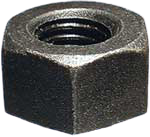
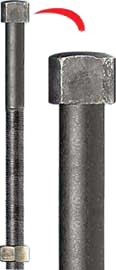
Nuts are another type of fastener with a threaded hole. Usually, a nut is the counterpart of bolt. Bolts can hold things together tightly thanks to the nuts. Nuts and bolts are used together to clamp two or more parts having unthreaded holes together. The two are kept together by a combination of several factors including the friction of their threads, stretching of the bolt, and compression of the parts that are to be held together.
To simplify, nuts are round discs that have a hole inside them used with bolts to fasten objects. In normal use, a nut-and-bolt joint holds together because the bolt is under constant tensile stress. The tensile stress pulls the nut threads against the bolt threads providing a clamping force that would prevent axial movement. However, when a joint is subjected to vibration, there is a tendency for the nut to easily loosen, therefore, specialized locking nuts are preferred in this situation.
A high-tensile nut means it can take on a high amount of stress before breaking. It can be used in environments which are often exposed to stressful and heated conditions. It’s used with bolts with less than the proof stress of the nut. A grade-5 nut is made of medium-strength carbon steel according to the Society of Automotive Engineers. It’s equivalent to the metric 8.8. Bolt. Since it’s medium-strength, grade 5 high-tensile is not advisable for use in heavy manufacturing applications.
A 2H nut has a medium strength. Its primary uses are for pressure valves and vessels, pipelines, pressure controls, chemical, gasoline, and oil storage systems, natural gas and steam storage, and transmission of chemicals, gasoline, oil, steam, and natural gas.
Basically it’s best for high temperature applications and high-pressure conditions because it’s designed to withstand extreme environment conditions.
A 2H Nut should not be confused with a 2HM Nut. Although they have the same chemical composition, the manner they are tested are different. The former requires only a small sample to be tested while the latter needs the whole population to undergo testing.
The hardness requirements and the proof load between the two also differ. The 2H Nut has a Brinell Hardness minimum of 147 (depending on the size) while the 2HM’s is 159. The proof load of a ½ in. 2H and 2HM are 24, 830 and 21,800, respectively.
Hook screws probably are one of the most used screws in the household. It is great for hanging up tools and other items in your room, workshop, or garage. A hook screw is a small hook with a threaded shank for screwing into woodwork or paneling. They are ideal for hanging pictures and mirrors but have limitless possible applications, you can use them as cup hooks or to hang up light ladders in the garage. Installing a hook screw is easy. To power drive hook screws, drill a pilot hole that is slightly smaller than the diameter of the hook screw shank. Feed the screw into the hole on your hook and line it up to the wall. Lastly, screw or hammer the hook into the wall. Another way to install your hook screw is through getting wall anchors for your screws. Drill a hole the same size as your wall anchor and insert your anchor in the hole you made. Place the screw into the hook and make sure that it is aligned with the anchor on your wall. Secure the screw in the center of your anchor.
U-bolt is an industrial fastener in the shape of the letter U with two threaded arms (or legs) extending from a curved base. A round u-bolt has smoother bends compared to a square bend one.
Uses of U-bolts are diverse which may include supporting pipework or attach a part to a pole, beam or wall. The “u” shape of U-bolt keeps it firmly in place, offering stability to the support.
The threaded ends are designed for use with washers and screws and can also be used with a crosspiece spanning both threaded arms of the bolt, to make it more secure in certain settings and uses. U-bolts are designed to be inserted through holes that have already been drilled or punched.
Often used as framing fasteners and anchors for foundations and roofs, pipe and conduit holders and bolts for motor and engine shaft components. Specifications of U-bolt includes material type, thread dimensions, inside diameter, and inside height.
A U-bolt is a bolt bent into the shape of the letter “u”. A square bend u-bolt refers to the style the u-bolt is bent. A square bend is more angular than the round-bend. U-bolts may appear simple, but the role of this material should not be underestimated. In fact, this element can be the difference between solid structures and on-site catastrophe. Usually, U-bolts are a jack-of-all trades in construction as they can offer a wide range of use. But most of the time, they are primarily used to support pipe works.
A major use of U-bolts is for hanging pipes. Because gravity can be hard on piping, the wrong setup can lead to disaster. By fixing a U-bolt to an overhead structure, beam, or ceiling, the risk of it happening can significantly reduce.
It can also work as a restraint. U-bolts keep piping from moving, banging into other structures, and wearing down. Aside from the mentioned features and functions of U-bolts, they are also common in building and construction applications like roofing and foundation stability. It can even secure motor and engine shaft components.
As U-bolts are now being used by a much wider market to clamp any kind of tubing, a more solid and convenient measurement system needs to be used. Five elements uniquely define any U-bolt namely material type, rod diameter, inside diameter, inside length, and thread dimensions.
A hub bolt is a kind of automotive bolt whose main function is to secure the wheel hub to the knuckle or the spindle. Hence, a hub bolt must be durable and reliable. Otherwise, an accident may occur.
Automotive bolts are threaded fasteners, with a head on end. Using these bolts need pre-drilled holes and nuts. Sometimes it may also require a washer to make sure it won’t loosen. The most common types of automotive bolts are hub bolts, head bolts, and u-bolts. Perhaps the most popular of these are the head bolts.
Moving on to the crucial role the bolts play in car’s safety, it is important to note that bolts must be securely fastened. A loose bolt may lead to tragic car accidents.
Automotive fasteners are made of different materials such as steel, iron, brass, nickel, and aluminum. Despite the differences in their built, one thing remains the same: they’re all made to withstand extreme environments.
TS bolt is a type of bolt that requires a specific torque. Bolts are one of the most used elements in construction and other industries as they are necessary for holding materials or objects together. Its parts include the head and a threaded cylindrical body. Nuts and washers are oftentimes partnered with it to secure the attachment.
Nothing can downplay its importance as a loose or lost bolt can mean the difference between a good working piece of equipment or just a pile of metal trash. Given this fact, it is also worth considering the material the bolt is made of.
F 10T rating means it has a yield strength of 900 min., tensile strength of 1000-1200 min., elongation of 14 min., and reduction of area of 40 min. Hardness-wise, it’s HrC 27~38.