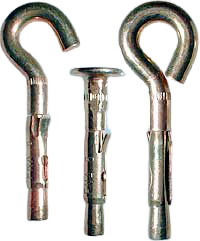
An expansion shield or expansion anchor is used for very heavy materials needed to be anchored into concrete, brick, or block. They are commonly used when the installation calls for shear load or the bolt will be exposed to vibration and side pressure.
There are different types of an expansion shield, namely, single expansion, double expansion, and lag screw expansion.
Structural members which need anchors to be attached to masonry involves ledger beam, girders, floor and roof diaphragms, and other materials that might need to transfer their load to the masonry. Not only do anchors transfer gravity loads to masonry but they also can transfer lateral loads as well.
There are a variety of applications possible for construction anchors. Typically, they are used to secure objects to materials that are normally resistant to screw or nails, for example, concrete. There are a lot of different types of anchors to choose from depending on your needs.
Anchor bolts are a type of steel anchors that are used to connect structural and non-structural elements to the concrete. The attachment is made through assembling of different components such as anchor bolts, steel plates, and stiffeners. Shear and tension forces are types of load that are transferred by anchor bolts. A plastic anchor sleeve is the go-to sleeve if one wants ease of use and affordable installation of anchor bolts into concrete.
A 4140 steel means it is a low alloy steel consisting of manganese, chromium, and molybdenum. It’s made by combining iron, carbon, and the three elements in an oxygen furnace. The latter are mainly for resisting corrosion. Once these are molten, they are allowed to cool then annealed, a process that involves heating steel at a certain temperature before allowing it to slowly cool down at a controlled rate. This process improves machinability and electrical conductivity.
A 4140 steel has a tensile strength of approximately 95,000 psi, the ultimate tensile strength. It’s known for its ductility, toughness, and hardenability.
Anchor bolts are a type of steel anchors that are used to connect structural and non-structural elements to the concrete. The attachment is made through assembling of different components such as anchor bolts, steel plates, and stiffeners. Shear and tension forces are types of load that are transferred by anchor bolts. A plastic anchor sleeve is the go-to sleeve if one wants ease of use and affordable installation of anchor bolts into concrete.
An A325 anchor bolt or ASTM A325 anchor bolt are high-strength structural bolts for various steel connections in different applications.
An ASTM A325 rating (now ASTM F3125) means the item has mechanical properties that range from ½ – 1” and 1⅛ – 1 ½”, tensile strength of 120 min and 105 min, and Yield strength of 92 and 81 minutes. It’s almost equivalent to a Grade 8.8 nut rating. It can be made from weathering steel, medium carbon steel, boron steel, and medium carbon alloy steel.
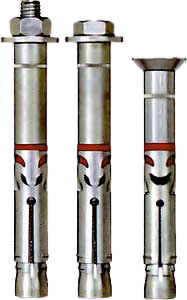
Sleeve anchors are incredibly versatile that you can use it in a wide variety of applications. These are also designed to be used in light to heavy duty fastening. When the bolt of the fastener is tightened, expansion occurs in the base material that creates a strong grasp and would allow distribution of load bearing weight.
As mentioned, these anchors are very adaptable. They can be used in a plethora of applications as simple as those at the home or for much larger operations. These can also be beneficial for projects that has base materials such as concrete, brick, and block.
Installing a sleeve anchor is simple but critical at the same time because correct installation is what would define its efficiency. The first step to install it is to drill a hole, make sure to clean the debris. Install the anchor afterwards and finish it with a hammer and torque wrench.
There are a variety of applications possible for construction anchors. Typically, they are used to secure objects to materials that are normally resistant to screw or nails, for example, concrete. There are a lot of different types of anchors to choose from depending on your needs.
Structural members which need anchors to be attached to masonry involves ledger beam, girders, floor and roof diaphragms, and other materials that might need to transfer their load to the masonry. Not only do anchors transfer gravity loads to masonry but they also can transfer lateral loads as well.
Sleeve anchors are used when adaptability is a requirement. They can be used with almost any material, even ones exposed to seismic loads. This is because a sleeve anchor expands once it’s tightened, which provides a strong connection that also distributes the weight. Sleeve anchors may be used for both heavy and light fastening requirements at home or to secure the joists of decking.