A G.I. flat washer means it’s galvanized iron. A galvanized iron flat washer received an additional zinc coating to protect the washer from weather-related degradation, that is, moisture and oxygen.
Generally, washers are defined as thin disc-shaped plates, typically with a hole through the center, that are used in conjunction with a threaded fastener such as a screw or a bolt. The usual functions of washers include distributing load, creating separation, preventing corrosion and wear, locking fasteners, and reduce vibration.
A flat washer, also known as a plain washer, is a type of washer that is a flat annulus or ring which is used to spread the load of a screwed fastener and prevent damage to the surface being fixed.
Flat washers are generally used to increase the bearing surface of a nut or fastener’s head. It spreads the clamping force over a larger area. Washers may be useful when dealing with soft materials and oversized or irregularly shaped holes. It is usually assembled around a bolt or screw, between the bearing surface of the fastener and the part to which it is attached. Flat washers are used to improve stress distribution, and to span large clearance hole.
Generally, washers are defined as thin disc-shaped plates, typically with a hole through the center, that are used in conjunction with a threaded fastener such as a screw or a bolt. The usual functions of washers include distributing load, creating separation, preventing corrosion and wear, locking fasteners, and reduce vibration.
A flat washer, also known as a plain washer, is a type of washer that is a flat annulus or ring which is used to spread the load of a screwed fastener and prevent damage to the surface being fixed.
Flat washers are generally used to increase the bearing surface of a nut or fastener’s head. It spreads the clamping force over a larger area. Washers may be useful when dealing with soft materials and oversized or irregularly shaped holes. It is usually assembled around a bolt or screw, between the bearing surface of the fastener and the part to which it is attached. Flat washers are used to improve stress distribution, and to span large clearance hole.
A B.I. flat washer means it’s black iron instead of galvanized iron. The latter has zinc to prevent corrosion. The disadvantage of this, however, is it can’t be used in gas lines as the zinc starts to react with gas, causing flaking, overtime.
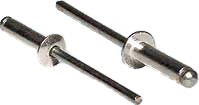
Blind rivets, also known as pop rivets, are a type of rivet that are commonly used in applications where there is limited access to the rear side. Blind rivets have two parts. The first part is called the rivet body, also known as the shell or hat. The second part is called the mandrel or stem. The mandrel is usually inside the rivet body.
When there is no or limited access to both sides of a compartment, a hole should be drilled first through the parts to be joined. The blind rivet is inserted through the drilled hole and the rivet body makes its contact with the parts. A blind rivet gun is placed on the rivet that pulls the mandrel into the rivet body. Due to this pull, its expansion and grip to the parts to be joined is created. Once gripped, the mandrel snaps and holds the rivet in its place permanently.
Choosing the right fixing for a surface depends primarily on the strength on the surface. Because hollow surfaces are weaker than others, it requires fixings specially designed for relatively thin and soft materials. Some of these are rubber-sleeved fixing, plastic collapsible fixing, plastic spread fixing, spring metal toggle fixing, and gravity toggle.
A gravity toggle is likened to the spring metal. The only difference between the two is the number of metal arms inserted through the hole. Gravity toggle has one while the latter has two.
A gravity toggle is only used in vertical wallboards and should not be reused. Otherwise, the toggle will fall off.
Fixings are a general term for items designed to attach objects to certain surfaces such as floors, walls, roofs, doors, and the likes, holding them steadily, usually permanently. They are a form of connector and play a particularly important role in construction.
Fixing is usually the key component in attaching larger or immovable objects. Examples include fixing a cupboard to a wall, a handle to a door, or a timber joist to a wall plate. Just like anchors, fixings also need to resist pull forces and shear forces.
Nuts are another type of fastener with a threaded hole. Usually, a nut is the counterpart of bolt. Bolts can hold things together tightly thanks to the nuts. Nuts and bolts are used together to clamp two or more parts having unthreaded holes together. The two are kept together by a combination of several factors including the friction of their threads, stretching of the bolt, and compression of the parts that are to be held together.
Toggle bolts and nuts are a kind of wall fastener for use on hollow walls, having a part that springs open or turns through 90° after it is inserted so as to prevent withdrawal. They are used for hanging objects on hollow walls such as drywall. It has wings that open inside a hollow wall, bracing against it to hold the fastener securely.
Both toggle nut and toggle bolt fasteners are easy to apply. Aside from that, using them have a lot of benefits including shock and vibration resistance and high shear and tensile strength.