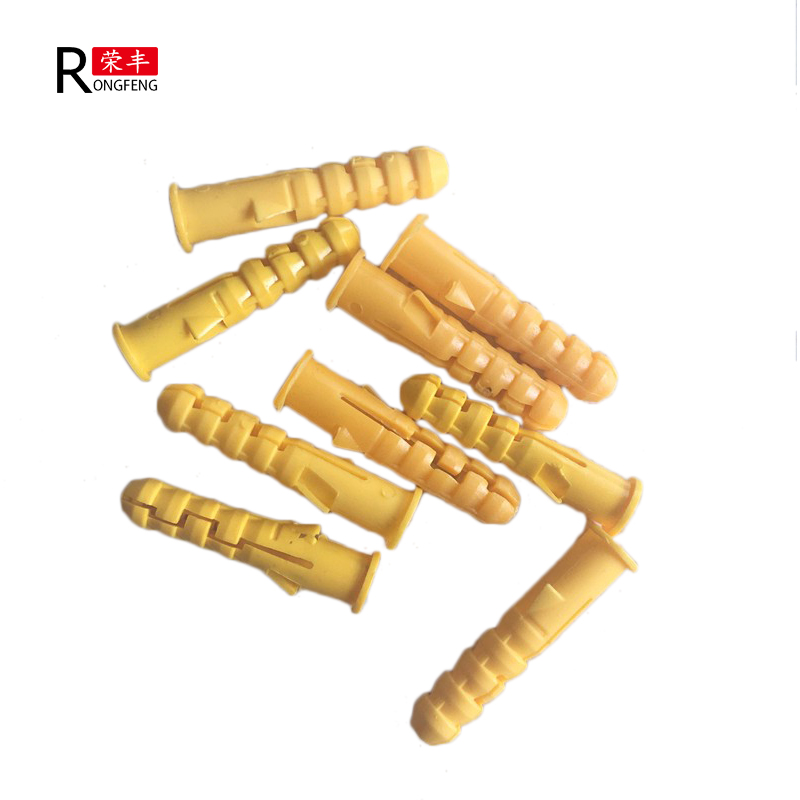
A nylon plug is a fixing used when driving a screw into a wall. It helps the screw fit into the hole drilled snugly. Using a nylon plug over a plastic one offers better heat resistance. A nylon plug does not go soft even when friction is applied.
Fixings are a general term for items designed to attach objects to certain surfaces such as floors, walls, roofs, doors, and the likes, holding them steadily, usually permanently. They are a form of connector and play a particularly important role in construction.
Fixing is usually the key component in attaching larger or immovable objects. Examples include fixing a cupboard to a wall, a handle to a door, or a timber joist to a wall plate. Just like anchors, fixings also need to resist pull forces and shear forces.
There are a number of choices for fixings depending on your needs and choosing the right fixing for the particular job is important. Lots of different types of fixings are available including screw, nails, bolts, wall plugs, mesh, hooks, eyes, hammer fixings, frame fixings, pipe fittings and a lot more.
Plastic fixings, more commonly known in the country as tox, is a type of wall plug or anchor. In other words, it is an insert just like a drop-in anchor. However, it may be used not only with concrete but wood and masonry walls as well.
Tox screw is needed when a screw has to be attached to a porous material or a brittle one. The tox screw helps support the weight of the object (e.g. wall fan).
Fixings are a general term for items designed to attach objects to certain surfaces such as floors, walls, roofs, doors, and the likes, holding them steadily, usually permanently. They are a form of connector and play a particularly important role in construction.
Fixing is usually the key component in attaching larger or immovable objects. Examples include fixing a cupboard to a wall, a handle to a door, or a timber joist to a wall plate. Just like anchors, fixings also need to resist pull forces and shear forces.
There are a number of choices for fixings depending on your needs and choosing the right fixing for the particular job is important. Lots of different types of fixings are available including screw, nails, bolts, wall plugs, mesh, hooks, eyes, hammer fixings, frame fixings, pipe fittings and a lot more.
It is known that chemical anchoring, a technique for fastening to concrete and similar substrates offers more flexibility than mechanical anchoring. With chemical anchoring, a resin is injected into the whole prior to insertion of the stud. Through this procedure, the chemical naturally fills in all irregularities and makes the hole airtight and waterproof, with 100% adhesion.
Chemical studs, also known as chemical anchors, are single unit non expansion type fasteners that are used in pre-drilled holes. They comprise of a chisel point stud available in flat cut or external hexagon type head, a nut, and a washer.
It is fixed through inserting a resin into the hole using a glass chemical capsule or injection type adhesive system. The stud is then inserted into the hole and rotated either by hammer drill for glass capsule or hand for injection type to allow for proper setting into the resin. The chemical stud can be loaded once appropriate curing time has been reached.
Fixings are a general term for items designed to attach objects to certain surfaces such as floors, walls, roofs, doors, and the likes, holding them steadily, usually permanently. They are a form of connector and play a particularly important role in construction.
Frame fixings are designed to connect pressed metal door or window frame and the wall. This prevents the frames from being pulled against the substrate and offer a long-lasting fixing of the frame. To maintain strength overtime, the long shaft of metal frame fixing provides rigidity and extra grip strength.
Metal frame fixings are recommended for applications such as window frames, door frames, and squared timbers. It is also compatible to a variety of building materials such as concrete, bricks, and others. They’re perfect for fixing metal door frame, fix plywood to metal frame, etc.
The primary advantage of using Universal Plug FU is its universal design, as the name suggests. This means that it may be used in almost any building materials, even concrete and aerated concrete. This is because the sleeve attaches tightly to building materials for maximum hold.
It also comes with an anti-rotation lock, which prevents the plug from rotating during installation. The collar that comes with it is to avoid slipping into the drill hole. This plug may be used with chipboard screws not more than 6mm and not less than 3mm.
Universal Plug FU is made of high-quality nylon and may be used for, but not limited to, installing wall cabinets, shelves (light-weight only), cornicing, curtain rails, mirrors, electrical installations, vertically perforated brick, and lamps.
Expansion Plug SX is the choice fixing for certain applications due to its material–high-quality nylon. Plug SX is commonly used in the following applications:
lighting, wardrobes, motion detectors, skirting, light shelves, mirror cabinets, letter boxes, TV consoles, trellis, folding shutters, and bath and toilet installations.
Aside from the high-quality material, Plug SX offers other advantages as well. For example, the 4-way expansion feature ensures the force is distributed evenly. Also, it ensures it can carry high loads in both solid and hollow materials.
Plug SX can be used in different materials such as concrete, aerated concrete, hollow blocks made from lightweight concrete, solid brick made from lightweight concrete, cavity floor slabs made from bricks and concrete, vertically perforated brick, perforated sand-lime brick, solid brick, solid sand-lime brick, natural stone with dense structure, ans solid panel made from gypsum.