It is known that chemical anchoring, a technique for fastening to concrete and similar substrates offers more flexibility than mechanical anchoring. With chemical anchoring, a resin is injected into the whole prior to insertion of the stud. Through this procedure, the chemical naturally fills in all irregularities and makes the hole airtight and waterproof, with 100% adhesion.
Chemical studs, also known as chemical anchors, are single unit non expansion type fasteners that are used in pre-drilled holes. They comprise of a chisel point stud available in flat cut or external hexagon type head, a nut, and a washer.
It is fixed through inserting a resin into the hole using a glass chemical capsule or injection type adhesive system. The stud is then inserted into the hole and rotated either by hammer drill for glass capsule or hand for injection type to allow for proper setting into the resin. The chemical stud can be loaded once appropriate curing time has been reached.
304 Stainless Steel is the material used for this capscrew. Type 304 Stainless steel is a T300 Series Stainless Steel austenitic. It has a minimum of 18% chromium and 8% nickel, combined with a maximum of 0.08% carbon. Knowing this, you may be confident that your 304 stainless steel stove bolt is corrosion-resistant.
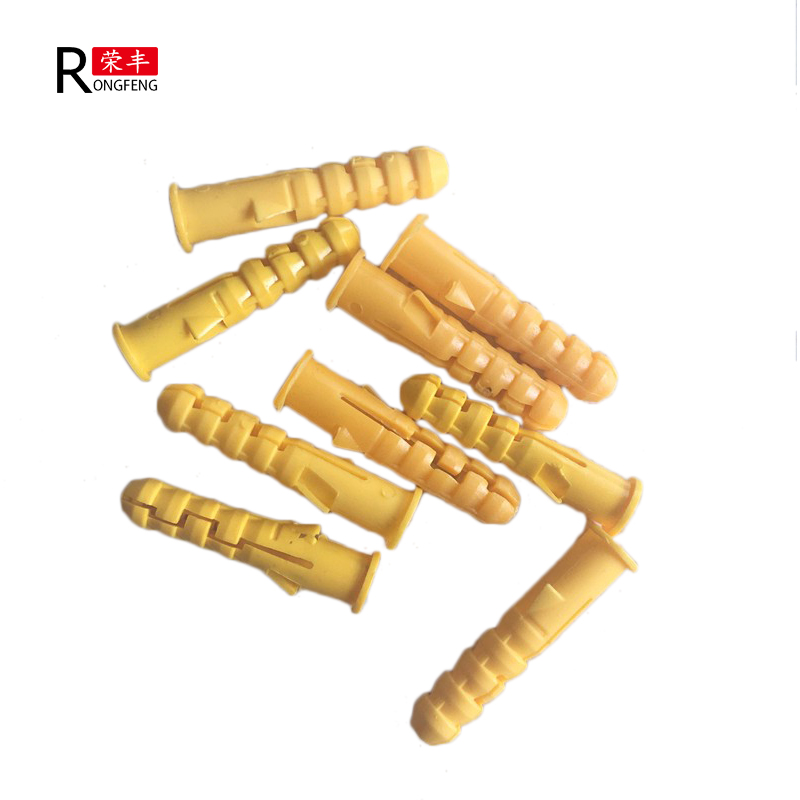
Plastic fixings, more commonly known in the country as tox, is a type of wall plug or anchor. In other words, it is an insert just like a drop-in anchor. However, it may be used not only with concrete but wood and masonry walls as well.
Tox screw is needed when a screw has to be attached to a porous material or a brittle one. The tox screw helps support the weight of the object (e.g. wall fan).
Fixings are a general term for items designed to attach objects to certain surfaces such as floors, walls, roofs, doors, and the likes, holding them steadily, usually permanently. They are a form of connector and play a particularly important role in construction.
Fixing is usually the key component in attaching larger or immovable objects. Examples include fixing a cupboard to a wall, a handle to a door, or a timber joist to a wall plate. Just like anchors, fixings also need to resist pull forces and shear forces.
There are a number of choices for fixings depending on your needs and choosing the right fixing for the particular job is important. Lots of different types of fixings are available including screw, nails, bolts, wall plugs, mesh, hooks, eyes, hammer fixings, frame fixings, pipe fittings and a lot more.
A G.I. flat washer means it’s galvanized iron. A galvanized iron flat washer received an additional zinc coating to protect the washer from weather-related degradation, that is, moisture and oxygen.
Generally, washers are defined as thin disc-shaped plates, typically with a hole through the center, that are used in conjunction with a threaded fastener such as a screw or a bolt. The usual functions of washers include distributing load, creating separation, preventing corrosion and wear, locking fasteners, and reduce vibration.
A flat washer, also known as a plain washer, is a type of washer that is a flat annulus or ring which is used to spread the load of a screwed fastener and prevent damage to the surface being fixed.
Flat washers are generally used to increase the bearing surface of a nut or fastener’s head. It spreads the clamping force over a larger area. Washers may be useful when dealing with soft materials and oversized or irregularly shaped holes. It is usually assembled around a bolt or screw, between the bearing surface of the fastener and the part to which it is attached. Flat washers are used to improve stress distribution, and to span large clearance hole.
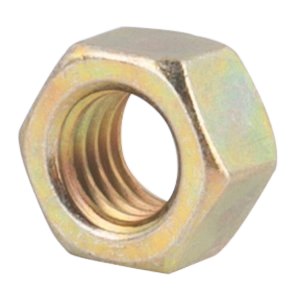
Hex bolts are also called hexagon screw head bolts, hex cap bolts, hex-cap screws, or machine bolts. They are a very common choice when it comes to construction and repair. There is a variety of sizes and diameters. Whichever bolt you choose, just make sure that it’s from a credible bolt and nut supplier.
The grading of a bolt refers to its material strength. As its name implies, ordinary hex bolts have a hexagonal head and come with machine threads for a firm and rough handling. Hex bolts are available with standard threading or full threading, depending on the length of the bolt.
YZP or Yellow Zinc Plating refers to the extra coating the bolt receives. It has a yellow or gold finish. Its purpose is to increase overall protection and avoid corrosion.
Washers are flattened, circular or disc-shaped piece of metal with a hole that are often used in conjunction with threaded fasteners. They are used to distribute the weight of a threaded fastener, washers are thin plates with a hole that can also be used as spacers, springs, wear pads, and locking device.
There are different forms of the lock washer: Belleville, curved disc, wave, split, toothed, tab, and wedge. These are used to prevent the loosening of a bolted joint brought about by vibration. Which is why hardened steel washers such as 304 Stainless Steel is necessary for high-quality bolted joints. The washers prevent the loss of pre-load when the torque is applied. 304 Stainless Steel is the material used for this washer. Type 304 Stainless steel is a T300 Series Stainless Steel austenitic. It has a minimum of 18% chromium and 8% nickel, combined with a maximum of 0.08% carbon. Knowing this, you may be confident that your 304 stainless steel stove bolt is corrosion-resistant.
Square head bolts used to be the go-to builts in almost any application back then. This is because it offers a large bearing area for gripping. Besides, their shapes make them easy to manufacture. This was particularly beneficial back in those days when machines were rare. These days, square bolt heads are still used, albeit rarely, when the application requires a maximum amount of torque and for aesthetic purposes. It provides that rustic look and matches fasteners in old structures.
However, because square head bolts require more twist to fasten, hex bolts replaced them. This is especially true for tight spaces where the application requires “good granularity of angles for a tool to approach from.”
304 Stainless Steel is the material used for this bolt. Type 304 Stainless steel is a T300 Series Stainless Steel austenitic. It has a minimum of 18% chromium and 8% nickel, combined with a maximum of 0.08% carbon. Knowing this, you may be confident that your 304 stainless steel stove bolt is corrosion-resistant.
Threaded rods are also called studs which are long rods that are threaded on both ends. They are designed to be used in tension. These rods are used in a variety of applications, many of which are related to manufacturing. Combustion gas engines often use threaded rods to secure the cylinder head to the engine block. Due to their dual-threading design, they are able to withstand both tension and vibrations.
Aside from manufacturing, a major use of threaded rod is in the construction industry. Threaded rods are often used when constructing buildings and bridges. They are a type of heavy-duty fasteners that is characterized by the presence of threading on both ends.
Unlike the galvanized threaded rod, which is coated by a thin layer of zinc to prevent corrosion, stainless steel threaded rod has an additional chromium. This makes it usable for all water applications, even salt water. Galvanized threaded rod, however, may not be used for saltwater applications.
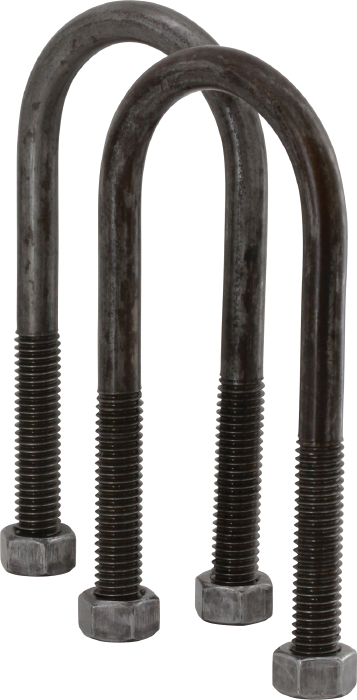
U-bolt is an industrial fastener in the shape of the letter U with two threaded arms (or legs) extending from a curved base. Uses of U-bolts are diverse which may include supporting pipework or attach a part to a pole, beam or wall. The “u” shape of U-bolt keeps it firmly in place, offering stability to the support.
The threaded ends are designed for use with washers and screws and can also be used with a crosspiece spanning both threaded arms of the bolt, to make it more secure in certain settings and uses. U-bolts are designed to be inserted through holes that have already been drilled or punched.
Often used as framing fasteners and anchors for foundations and roofs, pipe and conduit holders and bolts for motor and engine shaft components. Specifications of U-bolt includes material type, thread dimensions, inside diameter, and inside height.
The difference between the ordinary and imported u-bolts are the materials used. While both are of high-quality, one may be preferred by others more than the other.