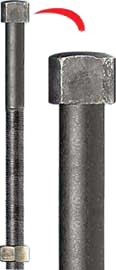
You can find a center bolt in a leaf spring assembly. It’s placed in the center of each leaf in an assembly (in the hole). There are usually 4-5 leaves, and each one carries a hole where a center bolt is inserted. The center bolt holds these leaves together and connects them to the axle through the bold head. This is what gives vehicles rear suspension.
A center bolt is vulnerable. Hence, it’s crucial for one to find high-quality center bolts to make sure it doesn’t break or bend. This is possible if the leaves are bound tightly together by a u-bolt. The latter clamps the leaves on each side of the center bolt. Both the center bolts and the u-bolts rely on each other to keep the leaf springs solidly bound. If one gets too loose, it may lead to breakage because the leaves put out too much pressure.
Fastening a u-bolt means there should be enough torque specs. Inaccurately fastening the u-bolt, as mentioned earlier, can damage the center bolt, causing inadequate suspension for your vehicle. The effect is not immediate, however. It may start from bending the center bolt then the leaves in the assembly follow.
The primary difference between the ordinary and imported center bolt is the materials used. Both are of high-quality, but the latter is more reliable for heavy applications.
From the name itself, a hexagonal nut is a nut with a hexagon-shaped head. Threads of the hex nut are either right-hand or left-hand. The size of hex nuts refers to the nominal thread diameter, which is typically from ¼” to 2 ½”.
Hex nuts are used with other fasteners such as bolts, threaded rods, anchors, studs, or screws. Other fasteners may also be used along with it.
A G.I. hexagonal nut means it’s galvanized iron. A galvanized iron hex nut received an additional zinc coating to protect the nut from weather-related degradation, that is, moisture and oxygen.
Using hex nuts with other fasteners need careful installment to ensure full thread engagement. When using with bolts or screws, make sure that either of these two is long enough that there’s two more full threads beyond the nut face once it’s tightened.
The primary difference between the ordinary and imported hex nut is the materials used. Both are of high-quality, but the latter is more reliable for heavy applications.
Flat washers are generally used to increase the bearing surface of a nut or fastener’s head. It spreads the clamping force over a larger area. Washers may be useful when dealing with soft materials and oversized or irregularly shaped holes. It is usually assembled around a bolt or screw, between the bearing surface of the fastener and the part to which it is attached. Flat washers are used to improve stress distribution, and to span large clearance hole.
Flat washers are commonly available in a variety of materials including aluminum, brass, nylon, silicon bronze, and stainless steel. Stainless steel flat washers are for use with austenitic stainless steel screws and nuts in general industrial applications where parts are subject to corrosion.
Stainless steels have been trusted for its capability to resist oxidation and corrosion, thanks to its chromium content. It is also known to withstand extreme temperatures that usually make ordinary materials brittle.
Stove bolts are constructed from sheet metal, have a slotted head. Stove bolts are sometimes referred to as a machine screw because they have a machine thread and round, flat or truss head. It may resemble a machine screw but usually having coarser threads and used for joining metal parts. These bolts got its name because they were originally used to fasten the metal portions of stoves together.
The head of the bolt is generally slotted for use with a standard or Phillips screwdriver. This bolt can be fastened with either a square or hex nut or in some cases, a lock washer.
304 Stainless Steel is the material used for this stove bolt. Type 304 Stainless steel is a T300 Series Stainless Steel austenitic. It has a minimum of 18% chromium and 8% nickel, combined with a maximum of 0.08% carbon. Knowing this, you may be confident that your 304 stainless steel stove bolt is corrosion-resistant.
It is known that chemical anchoring, a technique for fastening to concrete and similar substrates offers more flexibility than mechanical anchoring. With chemical anchoring, a resin is injected into the whole prior to insertion of the stud. Through this procedure, the chemical naturally fills in all irregularities and makes the hole airtight and waterproof, with 100% adhesion.
Chemical studs, also known as chemical anchors, are single unit non expansion type fasteners that are used in pre-drilled holes. They comprise of a chisel point stud available in flat cut or external hexagon type head, a nut, and a washer.
It is fixed through inserting a resin into the hole using a glass chemical capsule or injection type adhesive system. The stud is then inserted into the hole and rotated either by hammer drill for glass capsule or hand for injection type to allow for proper setting into the resin. The chemical stud can be loaded once appropriate curing time has been reached.
Fasteners such as socket head cap screws, also known as Allen Head screws, have sockets within their heads so that Allen wrench could secure the screw. A socket head capscrew, also known as socket cap screw, socket screw, or allen bolt is a screw characterized by its head having a hexagonal socket. Allen or hex socket is the primary driver used and is to be torqued using an Allen wrench, also called a hex key. Allen socket screws are often seen as advantageous over the normal Philip’s head. Allen screw head has six pressure points while the other one has only four. With more pressure points, it is easier to grip the screw making Allen screws preferable.
Capscrews fasten machines together with the help of a nut. When tightened, capscrews fastened different parts together using the tensile load that’s created when the screws are tightened. This is because this action creates stretching of the screws.
Unlike the stainless steel allen socket-head capscrew, this one has less protection against corrosion although it’s durable just the same.
A B.I. hexagonal nut means it’s coated with black iron instead of galvanized iron. The latter has zinc to prevent corrosion. The disadvantage of this, however, is it can’t be used in gas lines as the zinc starts to react with gas, causing flaking, overtime. So using B.I hex nut in such applications is better.
From the name itself, a hexagonal nut is a nut with a hexagon-shaped head. Threads of the hex nut are either right-hand or left-hand. The size of hex nuts refers to the nominal thread diameter, which is typically from ¼” to 2 ½”.
Hex nuts are used with other fasteners such as bolts, threaded rods, anchors, studs, or screws. Other fasteners may also be used along with it.
Using hex nuts with other fasteners need careful installment to ensure full thread engagement. When using with bolts or screws, make sure that either of these two is long enough that there’s two more full threads beyond the nut face once it’s tightened.
The primary difference between the ordinary and imported hex nut is the materials used. Both are of high-quality, but the latter is more reliable for heavy applications.
From automotive to marine, coastal, and high temperature environments, this specific type of bolt can be used—the ordinary hexagonal bolt, or hex bolt. As its name implies, ordinary hex bolts have a hexagonal head and come with machine threads for a firm and rough handling. Hex bolts are available with standard threading or full threading, depending on the length of the bolt.
Hex bolts are also called hexagon screw head bolts, hex cap bolts, hex-cap screws, or machine bolts. They are a very common choice when it comes to construction and repair. There is a variety of sizes and diameters. Whichever bolt you choose, just make sure that it’s from a credible bolt and nut supplier.
A B.I. hex bolt means it’s black iron instead of galvanized iron. The latter has zinc to prevent corrosion. The disadvantage of this, however, is it can’t be used in gas lines as the zinc starts to react with gas, causing flaking, overtime.