Both wafer screws and tek screws are self drilling screws. This means you don’t need to drill a hole before installing these screws. Of course, however, tek screws can be used on soft materials only such as wood and thin metal. Its self-tapping thread and drilling point allow them to be installed without using a drill.
Screws are headed and have a cylindrical, threaded body as well. However, the thread on screws are capable of piercing a surface. Also screws do not require nuts and washers to keep them in place. For this reason, screws may be drilled directly into a surface while bolts require a pre-drilled hole. This is why the opposite end of screws are usually sharp–to help pierce a surface easily.
Screws are also a major category of threaded fasteners. Screws and bolts share a lot of likenesses such as being made of metal and being characterized by a helical ridge. They are both used to fasten materials by the engagement of the screw thread or the external thread with a similar internal thread in the matching part.
Nuts are another type of fastener with a threaded hole. Usually, a nut is the counterpart of bolt. Bolts can hold things together tightly thanks to the nuts. Nuts and bolts are used together to clamp two or more parts having unthreaded holes together. The two are kept together by a combination of several factors including the friction of their threads, stretching of the bolt, and compression of the parts that are to be held together.
To simplify, nuts are round discs that have a hole inside them used with bolts to fasten objects. In normal use, a nut-and-bolt joint holds together because the bolt is under constant tensile stress. The tensile stress pulls the nut threads against the bolt threads providing a clamping force that would prevent axial movement. However, when a joint is subjected to vibration, there is a tendency for the nut to easily loosen, therefore, specialized locking nuts are preferred in this situation.
A flange nut is with an integrated washer, which looks like a wide flange at one end. The purpose of this flange is for the distribution of pressure as the nut is being secured in place, particularly in an uneven surface. The flange may also be serrated if locking action is needed.
Battery terminals are the electrical contacts that connect a charger or load to a battery. They consist of recessed female threads to attach bolts or other adapters. The bolts can either be the positive or the negative terminals. These bolts are replaceable just in case the current ones start to malfunction.
Bolts are one of the most common basic hardware parts you can see in any industry–automotive, construction, agriculture, etc. Bolts definition is they are mechanical fasteners that connect different parts. Its parts include the head and a threaded cylindrical body. Bolts are usually used with washers and nuts to lock them in position and prevent loosening or crushing. One reason bolts are popular across all industries is that it makes assembly, disassembly, and reassembly easier compared to permanent fastening such as welding.
Bolts should not be confused with screws, however. As mentioned previously, bolts definition is they are mechanical fasteners that connect different parts. Screws are also mechanical fasteners; however, how they look and how they are used are different.
A set screw is the type of screw used if a nut is not needed or cannot be incorporated in the application. It’s also called a blind screw or a grub screw. Set screws are mainly used when one needs to secure an object against another object or within another object, for example, a pulley to a shaft or a potentiometer knob. The set screw locks it in place. Set screws are driven into a threaded hole in the outer object and then tightened against the inner one. What sets set screws apart from the other screws is that they’re fully threaded.
An allen socket set screw is a screw characterized by its hexagonal point type. It’s driven by an internal-wrenching drive. Allen or hex socket is the primary driver used and is to be torqued using an Allen wrench, also called a hex key. Allen socket screws are often seen as advantageous over the normal Philip’s head. Allen screw head has six pressure points while the other one has only four. With more pressure points, it is easier to grip the screw making Allen screws preferable.
304 Stainless Steel is the material used for this set screw. Type 304 Stainless steel is a T300 Series Stainless Steel austenitic. It has a minimum of 18% chromium and 8% nickel, combined with a maximum of 0.08% carbon. Knowing this, you may be confident that your 304 Stainless Steel Allen Socket Set Screw is corrosion-resistant.
An axle is the rod or shaft that connects the wheel and the vehicle. It rotates and supports the weight of the vehicle. An axle stud bolt is what keeps the axle connected to the stud.
A stud is a relatively long rod that is threaded on both ends; the thread may extend along the complete length of the rod. It usually has no head, and simply acts as a threaded rod onto which nuts can be attached.
Bolts are one of the most common basic hardware parts you can see in any industry–automotive, construction, agriculture, etc. Bolts definition is they are mechanical fasteners that connect different parts. Its parts include the head and a threaded cylindrical body. Bolts are usually used with washers and nuts to lock them in position and prevent loosening or crushing. One reason bolts are popular across all industries is that it makes assembly, disassembly, and reassembly easier compared to permanent fastening such as welding.
Bolts should not be confused with screws, however. As mentioned previously, bolts definition is they are mechanical fasteners that connect different parts. Screws are also mechanical fasteners; however, how they look and how they are used are different.
Fasteners such as socket head cap screws, also known as Allen Head screws, have sockets within their heads so that Allen wrench could secure the screw. A socket head capscrew, also known as socket cap screw, socket screw, or allen bolt is a screw characterized by its head having a hexagonal socket. Allen or hex socket is the primary driver used and is to be torqued using an Allen wrench, also called a hex key. Allen socket screws are often seen as advantageous over the normal Philip’s head. Allen screw head has six pressure points while the other one has only four. With more pressure points, it is easier to grip the screw making Allen screws preferable.
Capscrews fasten machines together with the help of a nut. When tightened, capscrews fastened different parts together using the tensile load that’s created when the screws are tightened. This is because this action creates stretching of the screws. 304 Stainless Steel is the material used for this capscrew. Type 304 Stainless steel is a T300 Series Stainless Steel austenitic. It has a minimum of 18% chromium and 8% nickel, combined with a maximum of 0.08% carbon. Knowing this, you may be confident that your 304 stainless steel stove bolt is corrosion-resistant.
A nylon plug is a fixing used when driving a screw into a wall. It helps the screw fit into the hole drilled snugly. Using a nylon plug over a plastic one offers better heat resistance. A nylon plug does not go soft even when friction is applied.
Fixings are a general term for items designed to attach objects to certain surfaces such as floors, walls, roofs, doors, and the likes, holding them steadily, usually permanently. They are a form of connector and play a particularly important role in construction.
Fixing is usually the key component in attaching larger or immovable objects. Examples include fixing a cupboard to a wall, a handle to a door, or a timber joist to a wall plate. Just like anchors, fixings also need to resist pull forces and shear forces.
There are a number of choices for fixings depending on your needs and choosing the right fixing for the particular job is important. Lots of different types of fixings are available including screw, nails, bolts, wall plugs, mesh, hooks, eyes, hammer fixings, frame fixings, pipe fittings and a lot more.
A set screw is the type of screw used if a nut is not needed or cannot be incorporated in the application. It’s also called a blind screw or a grub screw. Set screws are mainly used when one needs to secure an object against another object or within another object, for example, a pulley to a shaft or a potentiometer knob. The set screw locks it in place. Set screws are driven into a threaded hole in the outer object and then tightened against the inner one.
What sets set screws apart from the other screws is that they’re fully threaded. However, there are types such as the Square Head Set Screw that has an unthreaded head. Square head set screw can be cone point, cup point, flat square, half dog square, or oval point square. Cone point has a cone shaped head and the tip has a sharp point. Cup point has a slightly circular and concave shape. Flat has a flat circle metal. Half dog is half as long as Full Dog. Oval point has a convex circular head.
Set screws are used with a hex socket, torx screws, square socket, or a slot–basically, any internal-wrenching drive.
Flat socket head cap screws are commonly used in machine assembly, especially for removable panels and parts. This element is a heavy-duty screw that is especially well suited to fastening thin plates, strips, moldings, and sheet metal parts. There are numerous applications that benefit from using flat-head socket screws.
Ideally, flat-head socket screws are used for thin sections where heads cannot protrude. It is also recommended for fastening where maximum flush and sidewall contact is required.
Allen screw is a screw characterized by its head having a hexagonal socket. Allen or hex socket is the primary drive used and is to be torqued using an Allen wrench, also called a hex key. Allen socket screws are often seen as advantageous over the normal Philip’s head. Allen screw head has six pressure points while the other one has only four. With more pressure points, it is easier to grip the screw making Allen screws preferable.
304 Stainless Steel is the material used for this capscrew. Type 304 Stainless steel is a T300 Series Stainless Steel austenitic. It has a minimum of 18% chromium and 8% nickel, combined with a maximum of 0.08% carbon. Knowing this, you may be confident that your 304 stainless steel stove bolt is corrosion-resistant.
Back then, nuts were commonly made with a simpler square head as they were easier to manufacture. However, due to the found advantages of hexagonal nuts or hex nuts, they became more popular.
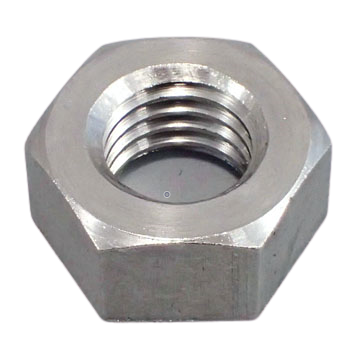
From the name itself, a hexagonal nut is a nut with a hexagon-shaped head. Threads of the hex nut are either right-hand or left-hand. The size of hex nuts refers to the nominal thread diameter, which is typically from ¼” to 2 ½”.
Hex nuts are used with other fasteners such as bolts, threaded rods, anchors, studs, or screws. Other fasteners may also be used along with it.
Using hex with other fasteners need careful installment to ensure full thread engagement. When using with bolts or screws, make sure that either of these two is long enough that there’s two more full threads beyond the nut face once it’s tightened.
304 Stainless Steel is the material used for this capscrew. Type 304 Stainless steel is a T300 Series Stainless Steel austenitic. It has a minimum of 18% chromium and 8% nickel, combined with a maximum of 0.08% carbon. Knowing this, you may be confident that your 304 stainless steel stove bolt is corrosion-resistant.